Master 5-Card PLO: The PLO Mastermind 30-Day Study Plan (Review & Roadmap)
Introduction: The 5-Card PLO Gold Rush (And Why You Are Losing)
If you are reading this, you’ve likely noticed the shift. The fish aren’t playing No-Limit Hold’em anymore. They aren’t even playing 4-Card PLO. They have migrated to 5-Card PLO (PLO5) on crypto poker sites like CoinPoker and Phenom Poker, where the action is faster, the pots are bigger, and the poker variance is absolutely sickening.
It is the modern Gold Rush. But there is a problem.
Most 4-Card players, maybe you included, think they can simply “add a card” to their existing strategy and crush. They open the same hands, c-bet the same textures, and stack off with the same overpairs. And they get slaughtered.
In 5-Card PLO, equities run closer than you can imagine. The “nuts” on the flop is often a dog by the turn. “Card dead” takes on a new meaning when you are dealt five cards and still can’t find a playable hand. Without a structured roadmap, you are just gambling.
The 5-Card PLO Mastermind 30-Day Study Plan claims to be that roadmap. This isn’t just a playlist of random hands; it is a comprehensive 5-Card Pot Limit Omaha course designed to strip away your bad habits and replace them with high-level PLO5 fundamentals.
We audited the full 30-day curriculum to see if this 5-Card PLO course actually helps you crush the games, or if it’s just $199/month to learn how to fold.
Why the “4-Card Strategy” Fails in 5-Card Games
Before we dive into the daily schedule, you need to understand why your current strategy is burning money. Most generic training sites won’t tell you this, but a specialized Pot Limit Omaha course for 5-Card must address these specific leaks:
1. The “Dangler” Problem In 4-Card PLO, a hand like As Ks Js 4d is often a standard open. The 4d is a “dangler” (a useless card), but the strength of the suited Broadway cards makes up for it. In 5-Card PLO, a dangler is a death sentence. If you are playing 4 cards against an opponent playing 5, you are giving up massive equity. This PLO course beats this rule into you: If all five cards don’t work together, you fold.
2. The Nuttiness Premium In 4-Card, the second-nut flush is often good enough to stack off. In 5-Card, drawing to the second nuts is financial suicide. With more cards in play, the likelihood of your opponent having the absolute nuts increases drastically. You need to learn to “nut peddle.”
The Curriculum: Week 1 — Preflop Rewiring (Days 1-7)
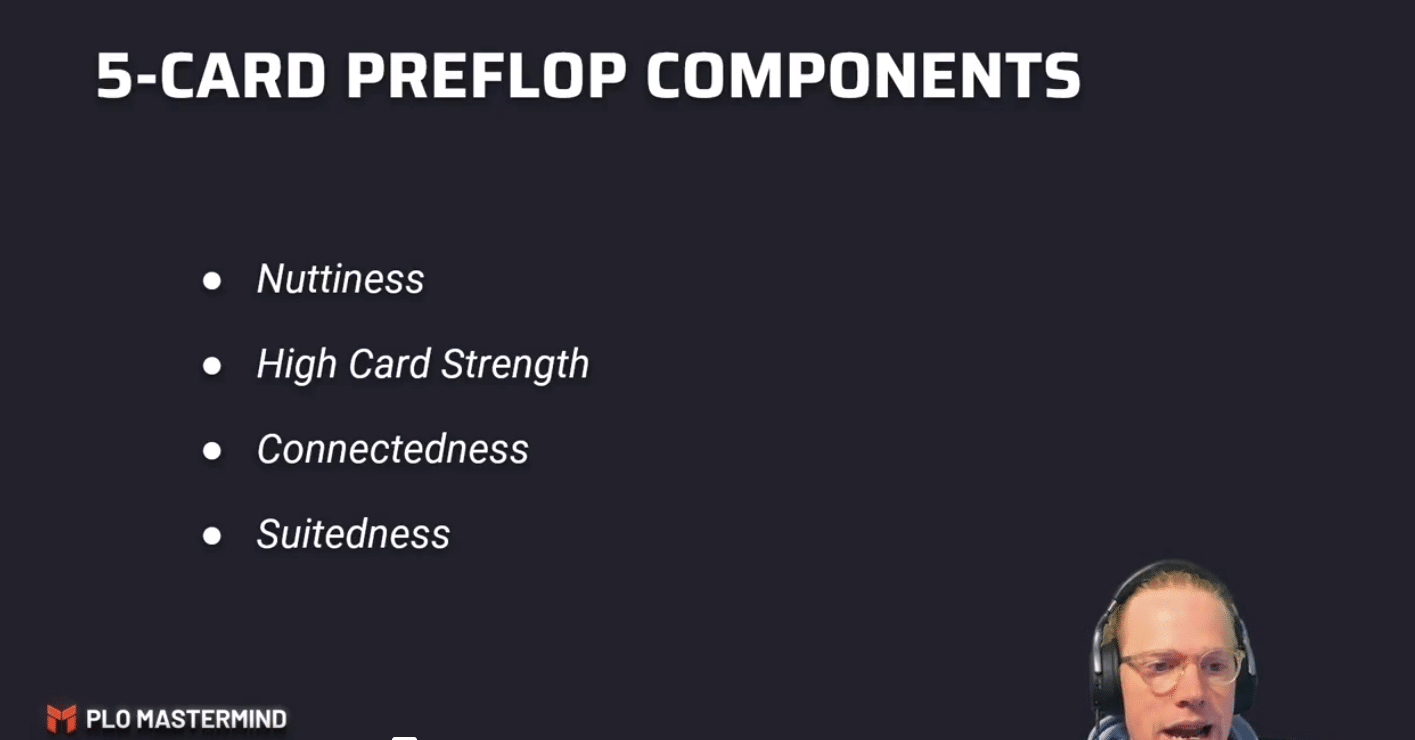
Goal: De-program your Hold’em and 4-Card instincts. Stop opening trash.
- Day 1: 5-Card Fundamentals. You start with the math. You’ll learn how equity distributions shift when everyone has five cards. (Spoiler: Aces get cracked way more often.)
- Day 2: The Preflop System. This 5-Card Pot Limit Omaha course introduces the “Five Card Formula.” It teaches you to categorize hands not just by strength, but by playability.
- Day 3: Transition Mistakes. The biggest one? Overvaluing
AAxxx. In 4-Card, Aces are a powerhouse. In 5-Card,AAwith three unconnected rags is a folding hand in many spots. - Day 4: Mastering the GTO PLO Trainer. You can’t guess anymore. This day sets you up with the PLO Trainer, teaching you the specific syntax to run 5-Card sims.
- Day 5: The 4 Pillars of Success. This lesson drills the hierarchy: Suitedness > High Cards > Connectivity > Pairs. In 5-Card, having double-suited high cards is the holy grail.
- Day 6: Preflop Acceleration. Drills designed to speed up your decision-making. You don’t have time to tank in app games.
- Day 7: Opening Ranges (RFI). The most critical day. You will learn that you must play tighter from Early Position (EP) in 5-Card than in 4-Card. Why? Because the threat of 3-bets behind you is higher, and you have zero maneuverability OOP.
The Curriculum: Week 2 — Aggression & Defense (Days 8-14)
Goal: Learn how to put chips in the pot without lighting them on fire.
Unlike a standard PLO course that suggests balanced aggression, this week teaches you Extreme Polarity.
- Day 8: 3-Betting. In 5-Card, you don’t 3-bet “merpy” hands. You 3-bet the top 5% (to isolate) and specific high-playability hands.
- Day 9: Defending the Big Blind. You will fold here more than you think. Defending weak double-suited hands is a leak because you will dominate yourself postflop.
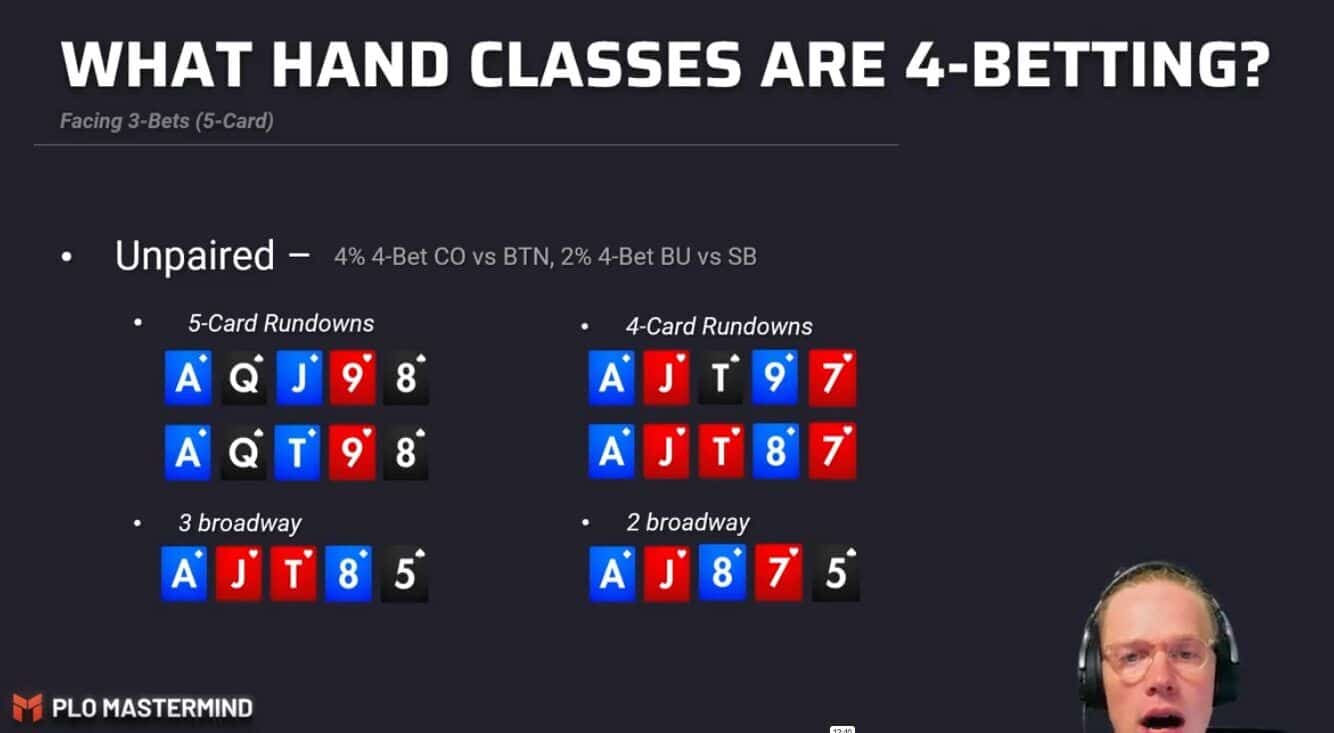
- Day 10: Facing 3-Bets. Stop calling with dominated rundowns. If you open
Kd Qd Jd 9s 7cand get 3-bet, do you call? The answer might surprise you. - Day 11: Squeezing. The easiest way to print money in loose 5-card PLO games. You learn which hands block the nuts and can jam over a raise + call.
- Day 12: Playing Aces (AAxxx). This is where most converts go broke. You learn the difference between “Stack-Off Aces” and “Set-Mining Aces.”
- Day 13: Common Preflop Leaks. A reality check on the double-suited trash you keep playing.
- Day 14: SRP IP Flop Overview. Introduction to postflop. You learn that in 5-Card, c-betting frequency often goes down because opponents hit the board harder.
The Curriculum: Week 3 — Postflop Physics & SPRs (Days 15-23)
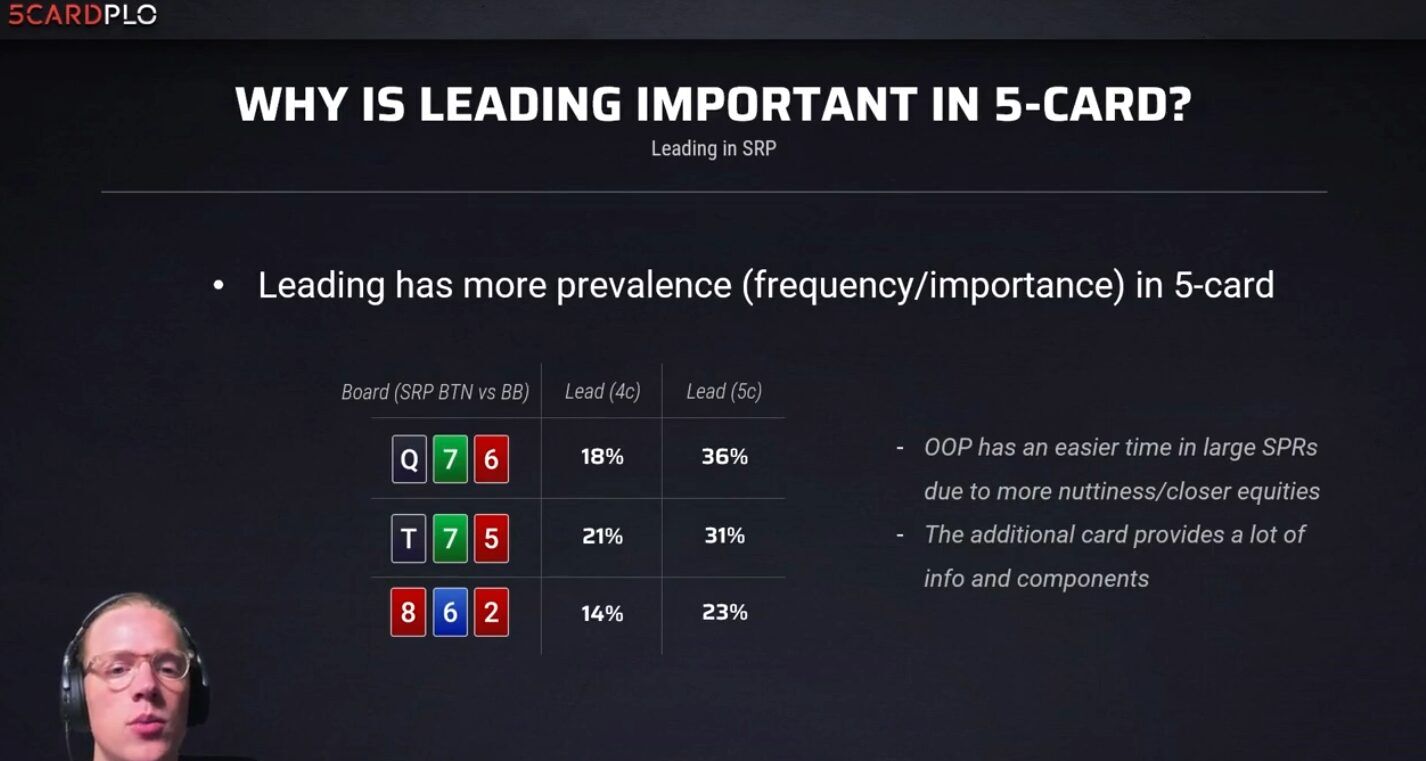
Goal: Where the edge is created. Applying the “Retreating Linear” strategy.
This is the section that separates a beginner 5-Card Pot Limit Omaha course from advanced training like This Is PLO. It focuses heavily on how SPR (Stack-to-Pot Ratio) dictates your entire strategy.
- Day 15: Unpaired Flops IP. Learn when to stab and when to check back to realize equity.
- Day 16: Check-Raising Mechanics. If you never check-raise, you are easy to beat. This day teaches you how to punish weak stabs.
- Day 17: Double Barreling. The turn is the “separator street.” Most players give up. You will learn to barrel cards that give you equity pickups (wraps, flush draws).
- Day 18: Defending vs. Barrels. Knowing when your blockers are fake. (Hint: Blocking the nut flush is less powerful when your opponent has 5 cards to find another flush).
- Day 19: C-Betting OOP. The hardest spot in PLO5. This lesson simplifies it: Check-Range is often your friend.
- Day 20: Leading (Donking). In 4-Card, donking is rare. In 5-Card, on boards that smash your range (like
9-8-7), leading is GTO. - Day 21: 3-Bet Pots OOP. How to play Broadway boards when you are the aggressor but missed.
- Day 22: 3-Bet Pots Low Boards. Navigating the minefield where your Aces are dead.
- Day 23: Stack-Off Thresholds. When is it correct to commit 100bb? This introduces the strict mathematical thresholds for “Nut” vs. “Non-Nut” stack-offs.
The Curriculum: Week 4 — The Ecosystem & Mastery (Days 24-30)
Goal: Survival, Rake, and Real Play.
- Days 24-25: Advanced 4-Bet Pots. High variance survival.
- Day 26: The 5-Card Ecosystem. Understanding Rake. In high-rake app games, VPIP must drop. This lesson shows you the math.
- Day 27: Game Selection. You can’t beat a table of 6 pros. Learn to spot whales and select seats aggressively.
- Day 28: Database Analysis. How to filter your tracker for “Red Line” leaks.
- Day 29: EV Analysis. Checking your math.
- Day 30: Play & Explain. A full session commentary at low stakes. This is gold watching a pro explain why he folded a hand you would have shoved.
Expert Insight: The “Retreating Linear” Concept
One of the hidden gems in this 5-Card PLO course (and specifically in the advanced documentation) is the Retreating Linear concept regarding SPR phases.
In 5-Card PLO, when you are in a medium SPR spot (let’s say SPR 3-5), your range shouldn’t be polar (Nuts or Air). It should be Linear.
- The Concept: You bet your strong hands, but as the board changes and the nuts change, your betting range “retreats.”
- Application: If you flop top set on
Ks 8d 4c, you bet. If the turn is9h, completing straights, you don’t barrel blindly. You check-call. You “retreat” to a defensive mode because in 5-Card, the likelihood that the opponent has the specificQ-J-Twrap is massive. - Why it works: Fish play “Fit or Fold.” By retreating, you keep their bluffs in and avoid paying off their nuts.
Essential Tools: You Cannot Win With Just Videos
You can watch every video in this PLO course, but if you don’t practice, you will fail. The variance is too high to learn by “feeling.”
- PLO Trainer Pro: You absolutely need the Pro tier for 5-Card solutions. Do not try to use 4-Card ranges for 5-Card spots. The equities are different.
- Tracking Software: You need DriveHUD2 to track 5-Card hands properly.
Verdict: Is the 5-Card PLO Mastermind 30-Day Study Plan Worth It?
The Bottom Line: If you are playing 5-Card PLO on apps or high-action sites, the swings are brutal. One bad session can cost you 10 buy-ins. If you are looking for a Pot Limit Omaha course that prevents even one bad stack-off per session, it pays for itself in a week.
Our Advice: Buy it for one month. Do the 30 days like your life depends on it. Cancel if you can’t hack the grind. But don’t enter the 5-Card streets without it.
Key Takeaways
- Don’t Just “Add a Card”: 4-Card strategies will get you crushed in 5-Card games. This PLO course de-programs your old habits (like overvaluing Aces) and replaces them with 5-Card specific physics.
- The “Retreating Linear” Edge: One of the most advanced concepts you’ll learn is how to switch from aggression to defence instantly when the board texture shifts, a move that exploits “Fit or Fold” players.
- Extreme Polarity: Unlike the balanced ranges in 4-Card, this Pot Limit Omaha course teaches you to play ultra-tight from Early Position and ultra-aggressive in squeezing spots.
- Tool Requirement: You cannot complete the curriculum without the PLO Trainer Pro tier ($199/mo). The daily “Train 100 Hands” drills are mandatory for building muscle memory.
Variance Management: This 5-Card Pot Limit Omaha course doesn’t just teach cards; it teaches survival. You will learn why you need 100+ buy-ins and how to handle 50-stack downswings without tilting.
FAQs
No. If you don’t know what a “pot odds” or “c-bet” is, this Pot Limit Omaha course will be too advanced. It is designed for players who already know how to play poker (Hold’em or 4-Card PLO) but want to transition to 5-Card specifically. If you are new, start with this PLO course.
Absolutely not. This is the fastest way to lose money. In 5-Card, equities run much closer, and hands that are monsters in 4-Card (like low rundowns) are often trash in 5-Card. You need specific 5-Card solution charts.
Not fully, but we have “GTO baselines.” The PLO Trainer uses MonkerSolver outputs to give you a baseline strategy. The goal of this 5-Card PLO course isn’t to play like a robot, but to know the baseline so you can deviate and exploit the fish.
Yes. The 5-Card PLO Mastermind 30-Day Study Plan relies on daily drills that are only available in the Pro tier. You cannot complete the “Train 100 Hands” homework or access the specific 5-Card postflop solutions without it.
We recommend at least 100 buy-ins for 5-Card PLO. The variance is higher than any other form of poker. If you are playing on volatile apps where the action is crazy, 150 buy-ins is safer.
Overview of all Pot Limit Omaha courses:
Starter Courses
- 4-Card PLO 30-Day Course Review
- 4-Card PLO From The Ground Up Course Review
- 5-Card PLO 30-Day Course Review
- 5-Card PLO From The Ground Up Course Review
Advanced Courses
- PLO Mastermind 6-Max Cash Game Course Review
- Solving The PLO Puzzle Course Review
- 6-Card PLO Blueprint Course Review