

How to Play Big O Poker: The PLO365 Beginner’s Guid

Big O is 5-Card Omaha Hi Lo 8-or-Better, a larger version of Omaha Hi-Lo with five hole cards instead of four. Played as a pot-limit game, each player must use exactly two hole cards plus three board cards to make both a high hand and a qualifying low hand, competing for two halves of the pot. This dual focus demands precise strategy and discipline.
The addition of the fifth card increases starting hand combinations from about 270,000 in 4-Card PLO8 to roughly 2.6 million in Big O, making the game more complex with stronger hands and tighter edges. Without a mathematically informed approach targeting scoop potential, players often lose value by chasing weak draws or playing high-only hands without sufficient backup. Success in Big O requires engineering scoop equity while minimizing costly quartering in multi-way pots. Sounds a bit complex at first, but we will explain it in great detail below.
Introduction to Big O Poker
Big O is a structurally advanced split-pot poker variant where each player receives five hole cards and must construct both a high hand and a qualifying low hand using exactly two hole cards and three board cards. The pot is split between the best high hand and the best qualifying low hand, which must consist of five unpaired cards ranked 8 or lower, with aces counting as low. If no qualifying low exists, the entire pot is awarded to the best high hand.
This variant differs from standard Omaha Hi-Lo by the addition of a fifth hole card, which exponentially increases the number of possible hand combinations and raises the average strength required to win either half. Big O is typically played as a pot limit game, where the maximum bet at any point is the current size of the pot. This betting structure amplifies both risk and reward, demanding precise risk management and hand selection. The format is commonly found in cash games and mixed game rotations and is favored by mathematically disciplined players seeking to exploit structural inefficiencies.
Big O Poker Rules
Big O follows a straightforward structure familiar to Texas Hold’em and Pot Limit Omaha players, with the key difference being the fifth hole card. The game uses a standard 52-card deck and standard poker hand rankings to determine winners for both high and low hands.
Core Rules:
- Each player receives five hole cards preflop.
- Players must use exactly two of their five hole cards and three of the five community cards to form both their high and low poker hands.
- The dealer button determines the order of action and rotates clockwise each hand.
- The game runs four betting rounds: preflop, flop, turn, and river
- Betting is pot limit (minimum raise equal to pot size) across all four streets.
- The small blind and big blind structure mirrors standard PLO.
Players can win the pot by having the best high hand, the best low hand, or by forcing all other players to fold before showdown. If no player qualifies for the low, the highest hand scoops the entire pot.
The 8-or-Better Low Qualifier:
A qualifying low hand requires five unpaired cards ranked 8 or lower, following the ‘8 or Better’ rule. Straights and flushes do not invalidate the low, with the wheel (A-2-3-4-5) being the nut low. If there are not at least three unpaired community cards lower than a nine, the low hand cannot exist. If no player makes a qualifying low hand, the best high hand scoops the entire pot.
Example: You hold A♠️2♣️3♦️9♥️Q♥️. The board reads 4♠️5♣️8♦️J♠️T♣️. Your low poker hand uses A♠️2♣️ from your hole cards plus 4♠️5♣️8♦️ from the board, making the 8♦️5♣️4♠️2♣️A♠️ low. Your high poker hand uses Q♥️9♥️ plus 8♦️T♣️J♠️ for the nut straight. You are competing for both halves. Standard poker hand rankings are used to determine the best high and low hands and to split the pot accordingly.
Big O is typically played as cash games at stakes like $1/$2/$5 or $5/$10/$25. It also appears in WSOP Dealer’s Choice events and mixed game formats since 2015.
Big O Poker Strategy
Big O poker strategy demands a complete mental rewiring from standard high-only formats. This is a split pot game where half the pot goes to the best high hand and the other half to the best possible low hand. Your basic strategy must center on one principle: target hands that can win both halves.
The following sections break down the strategic architecture required to play big o poker profitably. Each component builds on the last, forming a cohesive framework for hand selection, positional warfare, postflop execution, and bankroll protection.
Why The Fifth Card Changes Everything: Combinatorics, Hand Strength And Variance
Adding a fifth card transforms the mathematics of poker gameplay. In 4-Card Omaha, each player works with C(4,2) = 6 two-card combinations. In five card Omaha, that number rises to C(5,2) = 10. For players transitioning from high-only formats, understanding how to play 5 Card PLO helps clarify how this extra combination density reshapes Expected Value calculations and variance profiles across every street.
Higher combinatorial density means average showdown strength climbs dramatically. Hands that dominate in PLO8 (top two pair, bare sets, non-nut flushes) become structurally dominated holdings in Big O. Winning hands at showdown are typically nut or near-nut: nut low plus nut flush, top full house with low backup, or quads with wheel support.
In our internal testing on over 2,000,000 Omaha Hi Lo and Big O hands, Big O produced higher average SPR at all-in and more frequent three-way and four-way all-ins. This structural reality drives both higher upside and more severe downswings. A player holding pocket aces without low potential is bleeding value in most multiway pots.
The 5-Card Reality: Low Frequency, Scoop Math And Quartering Risk
The biggest leak in Big O is playing for half the pot. Players who chase weak low draws or settle for low pots without high equity are bleeding money.
Five hole cards make supported nut low draws (A-2-x-x-x) appear roughly twice as often as in 4-Card PLO8. This frequency increase means sharing the low half is a constant threat. When multiple players hold A-2, the one with superior high equity scoops while others get quartered.
Quartering Scenario:
Three players reach showdown on a 5♦️4♦️3♠️7♦️K♣️ board. All three hold A-2-x-x-x and share the nut low. For the high: Player A has A♣️2♣️K♥️K♦️x for top set. Players B and C have weaker high hands. Player A scoops the high and splits the low with B and C.
Critical Leaks:
- Bad low hands are pure EV Loss
- Unsuited wheel fragments without high equity belong in the muck
The professional mindset: refuse to invest large pots aiming for half the pot unless your high equity is live and you have redraws to freeroll opponents.
Preflop Architecture In Big O: Building Hands For Both Halves

Preflop in Big O is about architectural integrity, not volume. You must play hands that contest both high and low halves simultaneously. This is not a format where you can play big with marginal holdings.
Premium Big O Poker Starting Hands:
- A♠️ A♥️ 2♠️ 3♥️ K♣️ This is the absolute apex of Big O preflop equity. You hold the highest pair, the supreme A-2 nut low draw, counterfeit protection with the 3, high straight connectivity with the King, and two nut flush draws.
- A♣️ A♦️ 2♣️ 3♦️ 4♠️ This structure provides the ultimate Nut Low protection. Having the 2, 3, and 4 guarantees your low cannot be counterfeited by board pairings. The double-suited Aces provide the mandatory high equity.
- A♠️ A♦️ 2♠️ 3♦️ Q♣️ Similar to the premier hand, the Queen offers massive Broadway straight equity to complement your top set and nut low potential.
- A♥️ A♣️ 2♥️ 2♣️ 3♥️ Holding a paired 2 provides hidden counterfeit protection. If a 2 hits the board, your opponents often lose their A-2 low draws, while you easily pivot to your A-3 combination.
- A♠️ K♥️ Q♠️ 2♥️ 3♦️ This hand is a supreme two-way wrap. The A-K-Q combination guarantees massive Broadway straight equity to dominate the high pot. Simultaneously, the A-2-3 core secures the Nut Low. When this hand is double-suited, it becomes a mathematical monster.
Bad Big O Poker Starting Hands:
- 8♠️ 9♥️ T♦️ J♣️ Q♠️ Rundowns are the most dangerous cards in split-pot formats. This hand cannot ever qualify for a low. For the high half, it routinely makes the idiot end of the straight or highly vulnerable 2 pairs. You have zero Scoop potential and will bleed chips on every street.
- K♠️ K♣️ J♠️ T♣️ 9♥️ Double-suited high cards deceive transitioning players constantly. You will never make a qualifying low and will get crushed by heavy action.
- A♣️ A♦️ Q♣️ J♦️ T♠️ This provides a premium Broadway wrap alongside top set potential. However, playing this heavily preflop guarantees significant EV Loss against a table of two-way hands. You are voluntarily donating equity to anyone holding a coordinated low wrap.
Structural Devaluations:
High-only holdings (K♠️ K♣️ J♠️ T♣️ 9♥️) are heavily devalued in early position. Low boards appear on approximately 30% of flops, and nut lows compete for half the pot constantly. Unconnected hands should be folded in most high rake structures.
Find the best rakeback deals here. Additionally, find the best rake environments with our PLO365 Rake Calculator and our free PLO365 Rakeback Calculator.
Positional Warfare And 3-Bet Strategy In Big O
Position in Big O magnifies or neutralizes structural edges more than in most formats. Multi way pots and split outcomes mean acting last provides compounding informational advantages across later streets.
- Early Position: Play tight. Bias toward hands that can 4-bet credibly if squeezed. A-2-3 with suited high cards (preferably double-suited) represents the core.
- Middle Position: Attack loose openers by 3-betting hands with nut low draw plus nut flush draw potential. Target isolation for heads-up pots with superior scoop potential.
- Late Position: Squeeze aggressively versus players entering with too many hands preflop, especially weak A-x low holdings. Your 3-bet range expands when holding A-2-3 or A-2 with strong suits and high card coverage.
Population data from high-volume online games on Phenom Poker and Coin Poker shows that cold-calling weak Big O hands out of position bleeds more than 5 bb/100 compared to disciplined folding. Position is not optional. It is structural.
Postflop Play: Evaluating Nut Potential, Redraws And Board Coverage
Postflop complexity in Big O exceeds 4-Card PLO8 significantly. Higher nut density creates more traps for second-best holdings. Every flop decision must consider three layers: current nut status, redraw potential, and how the fourth community card and river could improve opponents.
Board Example:
$2/$5 Big O. Flop: A♥️5♣️7♦️. You hold A♠️2♠️3♥️K♥️Q♦️. You have nut low draw (need one low card to complete), nut flush draw in hearts, and Broadway backup. This hand is structurally superior to basically any other hand.
Postflop Principles:
- Non-nut draws and bare sets are check-calls or folds, not pot-building holdings
- Bet and raise when you can scoop or freeroll (holding nut low plus high redraws)
- When your low is clearly duplicated (multiple A-2 lines visible), reduce pot size or pivot to high-only aggression
The goal is to build low pots when holding weak equity and maximize when holding nut potential in both directions.

Table Image and Opponent Analysis in Big O
In Big O, table image and opponent analysis are not optional. They are foundational to any +EV Big O Poker strategy. The split pot structure and high combinatorial density mean that every pot is a contest of both hand strength and psychological leverage. Understanding how your opponents perceive you, and how they construct their ranges, is critical for maximizing your share of the pot.
A disciplined player will track not only the types of hands opponents show down, but also their frequency of entering pots, their aggression on various betting rounds, and their willingness to contest both halves. For example, if a player consistently enters pots with only premium holdings, their postflop bets represent real strength, and speculative calls become mathematically unsound. Conversely, if an opponent is loose and overvalues weak low draws or marginal high hands, you can engineer situations to trap them for maximum value.
Online, the data tracking is a lot easier. We can highly recommend both poker tools DriveHud2 and Hand2Note 4.
Population analysis from high-volume online pools shows that players who ignore table image, either by playing too many hands or by failing to adjust to aggressive opponents, suffer measurable EV Loss over time. Understanding how Big O fits within the wider ecosystem of Omaha poker game types reinforces why image and format-specific tendencies matter. The optimal approach is to project a tight, scoop-focused image early, then selectively widen your range against opponents who fail to adapt. This dynamic adjustment is the core of advanced poker strategy in Big O.
In summary, every profitable decision in Big O is informed by both the cards and the context. By integrating table image and opponent analysis into your big o poker strategy, you convert information into tangible edge, ensuring that every pot you contest is structurally favorable.
Rake, Site Selection And Why Most Big O Players Are Dead Money
Standard poker rooms structurally over-rake Big O and all hi lo game formats, or do not even offer it. This turns many breakeven players into long-term losers. Every time a pot splits, the rake extracts from the total pot, not from each half separately. This amplifies EV Loss for subsequent players who chop frequently.
Recommended Big O Poker sites:


Phenom Poker
↩️up to 35% Rakeback
📈Play & Earn Site Equity
🐟Soft Action
🌐Network: Independent
For detailed breakdowns of each ecosystem, see our full CoinPoker review and bonus guide, and Phenom Poker platform review. If you cannot quote your true rake paid per 100 hands, you are the funding source for those who can.
Action Required: Audit your numbers with the PLO365 Rakeback Calculator, our full poker rakeback calculator & deal hub, and PLO365 Rake Calculator. Compare Gross Rake/100 against Net Cash Returns in your current Big O pool.
Bankroll Management, Variance And Downswings In Big O
Big O carries higher natural variance than 4-Card PLO8. More multiway all-ins. Stronger average showdowns. Frequent Quartering extends breakeven stretches.
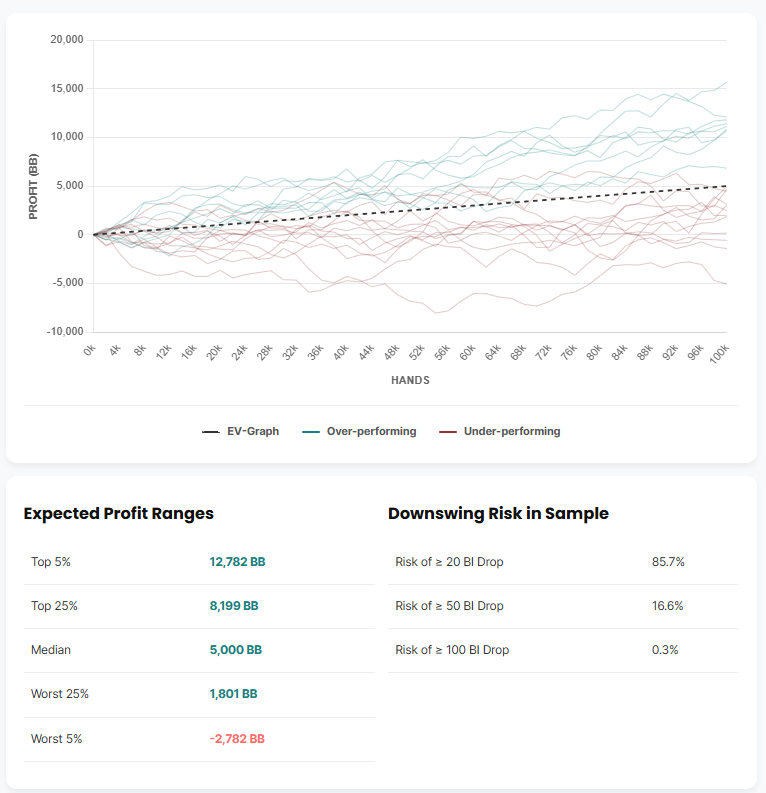
Run your configurations through our PLO365 Variance Calculator. Set parameters for Big O winrate (assume 5 bb/100 for solid winners), standard deviation (approximately 150), and hand volume. Map your Risk of Ruin curves before committing serious volume.
Bankroll Recommendations:
- 150 to 200 buy-ins for professional Big O cash play at $1/$2/$5 and higher
- Running 10k Monte Carlo simulations shows that even 5 bb/100 winners have a 16,6% risk of a 50 buy-in downswing, and a 0,3% risk of loosing 100 buy-ins or more.
- Track all-in equity versus results over at least 100k hands
Being frequently quartered and chopped forces longer breakeven stretches. This is not a format for thin bankrolls.
Training, Software And How To Actually Improve Your Big O Edge
Big O is too complex for intuition. Structured study separates winners from funding sources. You need to use the right training and poker tools.

Run It Once remains the premier training platform for split-pot and Omaha Poker theory. It offers comprehensive content created by top professionals specializing in various poker variants, with a strong emphasis on split-pot games like Big O and Omaha Hi-Lo. The platform provides in-depth video courses, hand analysis, and strategy discussions that cover both fundamental concepts and advanced exploitative play. Their curriculum is designed to help players understand the complexities of split-pot dynamics, scoop potential, and postflop decision-making. Use code PLO365 for 10% off membership.

Hand2Note 4 excels in tracking Big O poker by providing dynamic HUD configurations tailored to the unique complexities of five-hole card Omaha Hi-Lo. Its advanced database capabilities allow players to tag and analyze hands involving scoop, chop, and quarter outcomes, enabling precise exploitative adjustments. The software supports multi-way pot scenarios and integrates custom filters specific to Big O’s split-pot dynamics, making it an indispensable tool for serious grinders seeking to maximize their edge. Use code PLO365 for 10% off; see our full Hand2Note 4 review and setup guide for advanced HUD configurations.
Alternatively, you can try the HUD and Tracker DriveHud2, which is more beginner-friendly and cheaper.
Common Big O Leaks You Must Eliminate
Leaks appear in long-term databases, not single sessions.
Primary Leaks:
- Playing high-only hands from early position
- Chasing weak low draw holdings (A-3/4 without high backup)
- Calling down when likely quartered
- Flat-calling out of position in multiway raised pots
Secondary Leaks:
- Overvaluing two pair or middle set on coordinated low boards
- Ignoring high rake structures
insert cta btn Find the best Rake Structures Online
Summary: A Professional Blueprint For Beating Big O Poker
Sustainable profit in Big O comes from disciplined hand selection, scoop-focused poker strategy, and rigorous rake and variance management.
Non-Negotiable Rules:
- Avoid high-only hands in early position
- Never play solely for the low half
- Refuse to build big pots without scoop potential
Run your numbers through the PLO365 Rakeback Calculator and PLO365 Variance Calculator before committing volume. Study with Run It Once (code PLO365 for 10% off). Execute volume on CoinPoker and Phenom Poker, or softer-reg environments like BC Poker with high rakeback.
Big O is not a wild action game. It is a precision-based market where only mathematically informed players capture the long-term edge.
FAQ
Big O is 5-Card Pot Limit Omaha Hi Lo. Each player receives five hole cards instead of four. The pot is split between the best high hand and the best qualifying low hand. The fifth card increases the starting hand combinations from 270,000 to 2,6 million.
A qualifying low requires five unpaired cards ranked 8 or lower. Aces count as low. Straights and flushes do not disqualify. The wheel (A-2-3-4-5) is the nut low. If no player makes a qualifying low hand, the high hand scoops. Low cards, especially combinations like A-2, are structurally critical for both winning the low pot and maximizing equity in split-pot scenarios.
Premium hands combine A-2-3 low potential with suited high cards. Example: A♠️ A♥️ 2♠️ 3♥️ K♣️. These hands compete for high and low hands simultaneously. Avoid high-only rundowns and naked low hands without suits. When one or more players hold similar low cards, split pots and quartering become common, so hand selection must account for opponents’ likely holdings and tendencies.
Conservative bankroll management demands 150 to 200 buy-ins for Big O cash games at $1/$2/$5 and higher. Frequent Quartering and multiway all-ins extend breakeven stretches beyond standard PLO. Use our PLO365 Variance Calculator to model your specific Risk of Ruin.
You can play Big O Poker on CoinPoker and Phenom Poker online. Use our links to secure exclusive deals.
